Defence
-
Home
-
Defence
Upcoming Batch : March 2025, Medium : Hindi & English, Mode : Classroom & LIVE – Online
Defence Course Registration Form
Introduction to Defence
Defence is a critical component of any nation’s sovereignty and security. In India, defence encompasses the military, paramilitary, and other forces that work to protect the country’s borders, maintain internal security, and respond to external threats. India’s defence system is vast, highly organized, and one of the largest in the world, reflecting its geopolitical significance and diverse security challenges.
Historical Perspective of Indian Defence
India’s defence legacy dates back to ancient times, with significant contributions from civilizations such as the Indus Valley, Maurya, and Gupta empires. Throughout history, India has demonstrated advanced military strategies, robust defence systems, and technological innovations
-
Ancient India: The Mauryan Empire under Emperor Ashoka had one of the earliest organized military structures, including infantry, cavalry, and war elephants. Treatises like Kautilya’s Arthashastra provide insights into military strategies and espionage. -
Medieval India: The Rajput, Mughal, and Maratha empires brought advancements in warfare, such as the use of cannons and innovative battlefield strategies. -
British Era: During colonial rule, India’s defence was restructured under the British East India Company, eventually evolving into a modern military framework.
Modern Indian Defence System
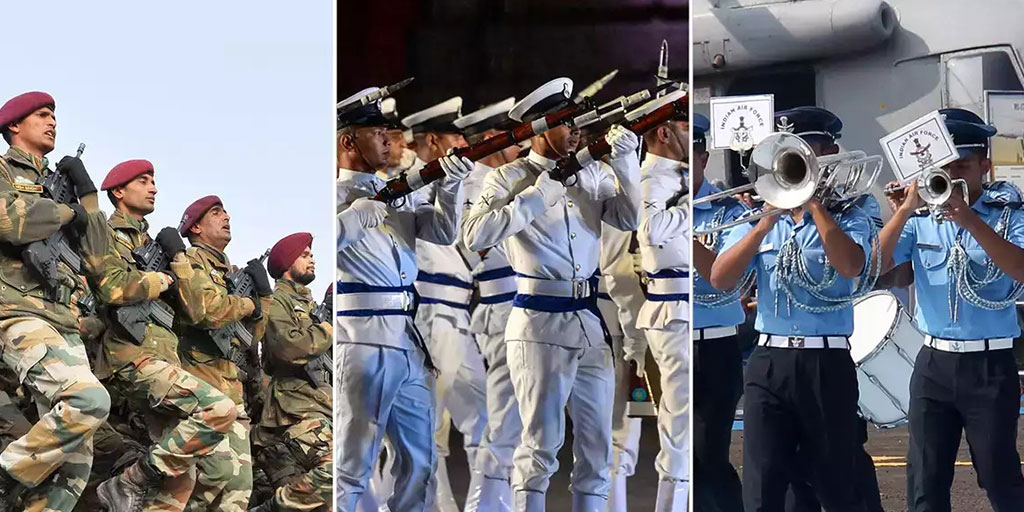
Post-independence, India established a robust and self-reliant defence infrastructure to safeguard its sovereignty. The Indian Armed Forces consist of three primary branches:
Indian Army
The Indian Army is the land-based branch and the largest component of the Indian Armed Forces. It is responsible for protecting the country’s territorial integrity and combating threats on land.
| Key Roles | Safeguarding borders Assisting in disaster relief operations Conducting counter-insurgency operations |
| Major Commands | The Army is divided into seven operational commands, each focusing on specific geographical areas. |
| Modernization | With initiatives like ‘Make in India,’ the Indian Army has adopted advanced weaponry, tanks, and surveillance systems. |
Indian Navy
The Indian Navy plays a vital role in securing maritime borders and protecting India’s interests in the Indian Ocean Region (IOR).
| Key Roles | Ensuring maritime security Conducting anti-piracy missions Supporting international peacekeeping efforts |
| Fleet Strength | The Navy operates aircraft carriers, destroyers, submarines, and maritime patrol aircraft. |
| Blue-Water Navy | India is transitioning to a blue-water navy capable of operating across oceans, extending its strategic reach globally. |
Indian Air Force (IAF)
The Indian Air Force ensures air supremacy and provides aerial support to the Army and Navy.
| Key Roles | Securing Indian airspace Conducting aerial reconnaissance and rescue missions Engaging in strategic bombing and transport operations |
| Advanced Technology | The IAF uses fighter jets like Rafale, Sukhoi Su-30MKI, and indigenous aircraft like Tejas. |
Paramilitary and Auxiliary Forces
India’s defence ecosystem includes paramilitary and auxiliary forces that complement the primary branches of the armed forces.
Central Armed Police Forces (CAPF):
-
Border Security Force (BSF): Guards India’s borders with Pakistan and Bangladesh. -
Central Reserve Police Force (CRPF): Manages internal security and counter-insurgency operations. -
Indo-Tibetan Border Police (ITBP): Secures the Indo-China border.
Coast Guard
-
Protects India’s maritime interests and conducts search-and-rescue operations.
National Security Guard (NSG):
-
Specialized in counter-terrorism and hostage rescue operations.
Territorial Army:
-
Comprises part-time volunteers who assist the regular Army during emergencies.terrorism and hostage rescue operations.
Introduction to Defence Exams in India
India, being one of the largest and most diverse countries in the world, has a robust defence system to safeguard its sovereignty and integrity. The country’s defence forces include the Indian Army, Indian Navy, Indian Air Force, and other allied services. These forces are responsible for maintaining national security and defending the nation against external and internal threats. To recruit capable and dedicated individuals into these services, various defence exams are conducted annually. These exams test candidates’ physical fitness, intellectual capabilities, and overall aptitude for military roles.
This comprehensive guide provides detailed information about defence exams in India, their significance, eligibility criteria, preparation strategies, and tips to excel.
Types of Defence Exams in India
Defence exams in India are broadly categorized into the following:
National Defence Academy (NDA) Exam
| Conducted by | Union Public Service Commission (UPSC) |
| Eligibility | For 10+2 pass-outs |
| Purpose | Entry into the Army, Navy, and Air Force wings of the NDA |
| Exam Pattern | Mathematics: 300 marks General Ability Test (GAT): 600 marks SSB Interview: 900 marks |
| Age Limit | 16.5 to 19.5 years |
Combined Defence Services (CDS) Exam
| Conducted by | UPSC |
| Eligibility | For Graduates |
| Purpose | Entry into the Indian Military Academy (IMA), Indian Naval Academy (INA), Air Force Academy (AFA), and Officers’ Training Academy (OTA) |
| Exam Pattern | Written Test: 300 marks (for IMA, INA, AFA) / 200 marks (for OTA) SSB Interview: 300 marks |
| Age Limit | IMA: 19-24 years INA: 19-22 years AFA: 19-23 years OTA: 19-25 years |
Air Force Common Admission Test (AFCAT)
| Conducted by | Indian Air Force |
| Eligibility | For graduates and postgraduates |
| Purpose | Recruitment in Flying Branch, Ground Duty (Technical and Non-Technical) branches |
| Exam Pattern | AFCAT Written Test: 300 marks EKT (for Technical Branch): 150 marks SSB Interview: Variable marks |
| Age Limit | Flying Branch: 20-24 years Ground Duty: 20-26 years |
Indian Coast Guard (ICG) Recruitment
| Conducted by | Indian Coast Guard |
| Eligibility | For 10+2 pass-outs and graduates |
| Purpose | Recruitment for Navik, Yantrik, and Assistant Commandant posts |
| Exam Pattern | Written Test Physical Fitness Test (PFT) Medical Examination |
| Age Limit | 18-22 years (relaxations for reserved categories) |
Territorial Army (TA) Exam
| Conducted by | Indian Territorial Army |
| Eligibility | For graduates |
| Purpose | Recruitment for part-time officers |
| Exam Pattern | Paper I: Reasoning and Elementary Mathematics (50 marks each) Paper II: General Knowledge and English (50 marks each) Interview |
| Age Limit | 18-42 years |
Indian Navy Entrance Test (INET)
| Conducted by | Indian Navy |
| Eligibility | For graduates and engineers |
| Purpose | Recruitment for Permanent Commission (PC) and Short Service Commission (SSC) officers |
| Exam Pattern | Sections: English, Reasoning & Numerical Ability, General Science, and General Knowledge SSB Interview |
| Age Limit | Varies by branch and category |
Defence Production and Self-Reliance
India has prioritized self-reliance in defence production to reduce dependency on imports. Key initiatives include:
Make in India
-
Promotes indigenous manufacturing of defence equipment. -
Encourages private sector participation in defence projects.
Defence Research and Development Organisation (DRDO):
-
Spearheads research and development in cutting-edge defence technologies -
Notable achievements: Agni and Prithvi missile systems, Tejas fighter aircraft, and Arjun tanks.
Public Sector Undertakings (PSUs):
-
Companies like Hindustan Aeronautics Limited (HAL) and Bharat Electronics Limited (BEL) contribute to defence manufacturing.
Strategic Partnerships and Alliances
India’s strategic partnerships with other nations enhance its defence capabilities and foster regional stability.
Key Partnerships
-
Collaboration with countries like the USA, Russia, Israel, and France for technology transfer and joint exercises. -
Membership in international forums like Quad and BRICS.
Defence Exercises
-
Regular military exercises with other nations, such as Malabar (with the USA and Japan) and Indra (with Russia).
Peacekeeping Missions
-
India is one of the largest contributors to United Nations peacekeeping missions worldwide.
Challenges in Indian Defence
Despite its strengths, India faces several challenges:
Geopolitical Tensions
-
Border disputes with China and Pakistan. -
Threats from terrorism and insurgency.
Modernization Gap
-
Balancing modernization with budget constraints. -
Integrating advanced technologies like AI and cyber defence.
Cybersecurity Threats
-
Growing risks of cyberattacks on critical defence infrastructure.
Logistics and Infrastructure
-
Ensuring efficient supply chains and infrastructure development in remote areas.
Future of Indian Defence
India’s defence roadmap focuses on strengthening its capabilities and achieving global recognition as a military power.
Technology Integration
-
Incorporating AI, drones, and robotics into defence systems. -
Developing space-based surveillance and satellite communication networks.
Indigenous Development
-
Expanding domestic manufacturing under initiatives like Atmanirbhar Bharat. -
Promoting innovation through startups in the defence sector.
Global Leadership
-
Participating in global peacekeeping and disaster response initiatives. -
Enhancing strategic influence in the Indian Ocean Region.
Frequently Asked Question
What are the main defense exams conducted in India?
Some of the major defense exams include:
- NDA (National Defence Academy)
- CDS (Combined Defence Services)
- AFCAT (Air Force Common Admission Test)
- Indian Coast Guard Recruitment
- Territorial Army
- Soldier & Officer Entries through Army, Navy, and Air Force Recruitment
What is the eligibility criteria for defense exams?
- Educational Qualification: Varies by exam (Class 12 for NDA; Graduation for CDS/AFCAT).
- Age Limit: Usually between 16.5 to 25 years, depending on the entry.
- Nationality: Must be an Indian citizen or fulfill conditions laid out for specific categories like Gorkhas or refugees.
- Physical Fitness: Candidates must meet specified physical standards for height, weight, and vision.
What is the selection process for defense exams?
The selection process generally involves:
- Written Examination (Objective/Descriptive based on exam).
- SSB (Services Selection Board) Interview for leadership and psychological evaluation.
- Medical Examination to ensure physical fitness.
- Training Academy Entry after final merit listing.
Can women apply for defense exams in India?
Yes, women can apply for various defense roles through exams like:
- CDS (Officers Training Academy – OTA)
- AFCAT (Air Force)
- Indian Navy SSC (Short Service Commission)
- NCC Special Entry Scheme (Army)
How can I prepare for defense exams effectively?
- Focus on General Knowledge, Mathematics, English, and Reasoning for written exams.
- Stay updated on current affairs and defense-related topics.
- Maintain physical fitness for endurance tests.
- Develop confidence, communication skills, and leadership qualities for the SSB interview.
Defence Course Registration Form